Governance Model
Governance Structure
Our governance structure reflects our commitment to transparency, efficiency, and alignment between our interests and those of our stakeholders. It is composed of four main bodies: the General Shareholders’ Meeting, the Board of Directors and its advisory committees, the Fiscal Council, and the Executive Management.
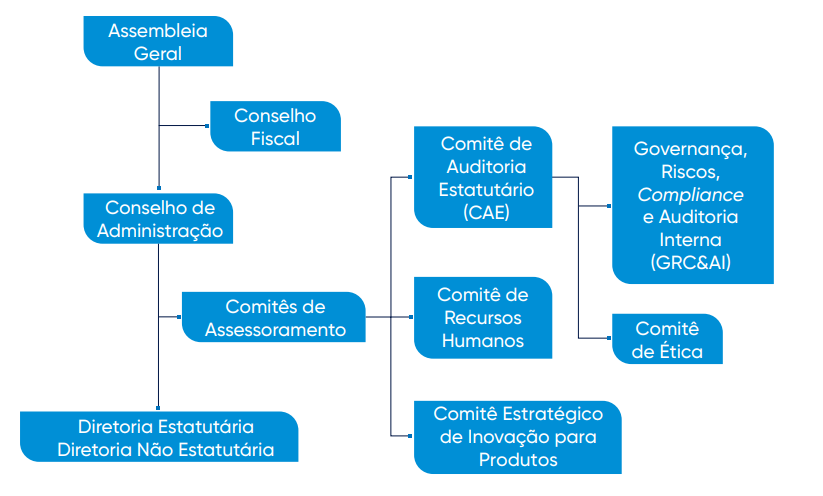
Governance History
For several years, we have adopted robust corporate governance practices. Since 2005, our financial statements have been audited by an external auditing firm from the “Big Four,” while we have also continued to conduct internal audits. In 2007, BNDESPar became a shareholder of the Company and contributed to our business strategy and corporate governance practices. In 2010, we began adopting International Financial Reporting Standards (IFRS) as issued and revised by the International Accounting Standards Board (IASB). Additionally, under our former corporate structure, even as a privately held company, we already applied certain practices typical of publicly traded companies, such as preparing quarterly information (ITR) since 2013. In 2012, we implemented a Board of Directors, which currently has a majority of independent members, and in 2013, we established a Fiscal Council, which currently has six members, including full and alternate members. In January 2014, we implemented a new integrated management system (ERP), SAP, to enhance information technology and strengthen internal process controls. The implementation project received the “Impact Awards 2014” at the 17th Annual ASUG Brasil Conference (SAP Users Association). Also in late 2014, we established the Statutory Audit Committee, composed of three members and chaired by an independent member of the Board of Directors.
In 2014, we completed our initial public offering (IPO), obtained our registration as a publicly held company with the Brazilian Securities and Exchange Commission (CVM), and listed our shares for trading on B3’s differentiated corporate governance segment known as Novo Mercado.
The Company further reinforces its commitment to transparency and sustainability through the adoption of Integrated Reporting as its main annual ESG disclosure document. This Integrated Report is prepared in line with internationally recognized references, including the IIRC guidelines, the IFRS Foundation’s Integrated Reporting Framework, the GRI Standards, and the principles of the UN Global Compact (a practice adopted since 2021). In addition, to enhance the credibility of the information disclosed, the most recent Integrated Report was audited by an independent auditor (KPMG), providing assurance over non-financial information for the fiscal year ended December 31, 2024, and was made publicly available together with the independent auditor’s report.
Our Corporate Governance Practices and the Brazilian Institute of Corporate Governance (IBGC)
Among the corporate governance practices recommended by the IBGC in its Code of Best Practices of Corporate Governance, we have adopted the following:
-
The Company’s share capital is comprised exclusively of common shares, granting voting rights to all shareholders;
-
Maintenance and disclosure of a register showing the number of shares held by each shareholder, identified by name;
-
Mandatory tender offer in the event of a share purchase that results in a transfer of corporate control to all shareholders—not only the controlling block holders. All shareholders must have the option to sell their shares under the same terms. The transfer of control must occur at a transparent price. In the event of the sale of the entire controlling block, the acquirer must make a public tender offer to all shareholders under the same terms as those granted to the controlling shareholder (tag-along rights);
-
Engagement of an independent auditing firm to review the Company’s financial statements and reports;
-
By-law provision for the installation of a Fiscal Council;
-
Clear definition in the bylaws of (a) the procedures for calling the General Shareholders’ Meeting, and (b) the process for electing and removing members, as well as the term of office, of the Board of Directors and Executive Management;
-
Adoption of a Board of Directors;
-
Transparency through public disclosure of the annual management report;
-
Unrestricted access to the Company’s information and facilities by members of the Board of Directors;
-
Resolution of conflicts that may arise between the Company, its shareholders, its officers, and members of the Fiscal Council through arbitration;
-
The General Shareholders’ Meeting is empowered to deliberate on: (a) increases or reductions of share capital and other amendments to the bylaws; (b) election or removal, at any time, of Board members and Fiscal Council members; (c) annual review of management accounts and approval of the financial statements; and (d) corporate restructuring and corporate actions, including transformation, merger, incorporation, spin-off, dissolution, and liquidation;
-
Selection of the venue for the General Shareholders’ Meeting in a manner that facilitates attendance by all shareholders or their representatives.